" />
|
||||
Email the author | About the author Barry Klemm enjoyed an array of abandoned careers before resorting to literature. He was a crane jockey, insurance clerk, combat soldier, advertising officer, computer programmer, cleaner, stagehand, postman, sports ground manager, builder's labourer, taxi-driver, film and TV scriptwriter and radio dramatist. He has published two novels for teen-age readers, The Tenth Hero, in 1997, and Last Voyage of the Albatross in 1998 through Addison Wesley Longman and Running Dogs, a novel of the Vietnam war by Black Pepper in 2000. |
||||
Shy, naïve nineteen year-old Griffin returns one night from the insurance office where he works to his parent’s home in the suburbs where he still lives, to discover that he has been drafted. Against the odds, he survives induction into the army where fierce sergeants set about transforming him into their version of a man—without a great deal of success. But he learns what he needs to know pretty quickly once they land him as a combat soldier in the Vietnam war. Faced with the worst horrors of human conflict, Griffin transforms into the most fundamental of humans—hunter-killer—the quintessential example of the most dangerous predatory animal ever to walk this planet. And then, just as suddenly, his time is up and he is dumped back into civilised society and expected to cope. Unable to resume any part of his former comfortable, happy existence, he sets about trying to be someone else—without much luck—until he falls in with radical draft-dodger Lew Sigg. Painfully, Griffin undergoes a 180° turn and becomes an anti-war protestor, more or less, but it solves nothing. Finally Lew, on the run from the law, takes him on a journey that will finally bring him to terms with himself. Chapters 13 and 20-31 of this book were originally published under the title Running Dogs by Black Pepper publishing in 2000. |
“I think the planet is in trouble and it’s screaming out for help. I believe you are the first to hear the voice of Gaia .” |
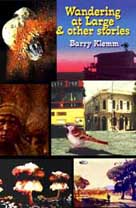
BRUNSWICK BUDGIE A fledgling receives flying lessons from an unlikely source WANDERING AT LARGE An old man goes to court to defend his dog from the dogcatcher. TRAVELS WITH THE WITCH A couple of tourists find themselves involved in a possible foreign intrigue. DIRTY FINGERNAILS A combat soldier strives to come to terms with R&R in Bangkok. PANIC MERCHANTA taxi-driver must talk his passenger out of committing murder. THE FLOOD Warrick faces the great Elizabeth Street flood. SNAPPING DOGS A sexual encounter leads to a confrontation with two militant feminist dogs. NOWHERE COMING BACK Simon inadvertently finds himself responsible for an entire outback community SLAVES Commuters start becoming dangerously sane STARFIRE The story of the man who was actually first in space THE CULL An ordinary man must make the most dreadful decision in all human history. |
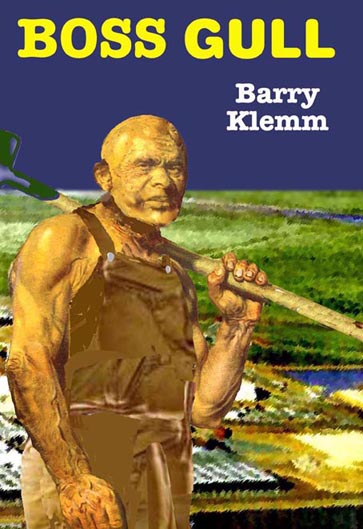
Way back in 1953, war veterans Frank Overton and Lyle Tynan manned the Moolanong garbage truck on its gruesome daily rounds of the fledgling suburb of Moolanong, a barren swampy place on the far outskirts of Melbourne. Over the next thirty-three years, as the suburb develops, the two men remain mates, linked by a tragic incident, and despite the fact that their lives follow very diverse courses.
Frank Overton exploits every opportunity to rise in the local council ranks and, aided by a small inheritance, is able to use his position to pull off a land deal—buying up an enormous swamp for a song and then using council facilities to have it reclaimed and subdivided, propelling him into the world of the rich and powerful. He builds a huge suburban empire, still based on garbage disposal but now fully diversified into property, construction and hi tech, and reaching out for the media. But along the way Frank incurs many debts, often of the more troublesome non financial kind, and the day is coming when those debts will have to be repaid.
Conversely, Big Lyle Tynan stays right where he is, boss of the yard at Moolanong Rubbish Tip. A huge man with giant muscles, no intellectual but not stupid either, Big Lyle watches as, over the years, society's need of his great physical strength diminishes through the increasing employment of machines until eventually it isn't needed at all. But when finally Frank blatantly replaces him with a machine, Big Lyle decides to stand and fight with devastating results.
After more than three decades, the day of reckoning has come and the two men meet to fight it out to the finish. For now Lyle is an urban avenging angel and his campaign is causing Frank's whole empire to sink back into the swamp from which it first arose.
|
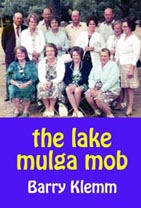
In a sleepy little wheat-belt town an old woman dies. Thus, once again, the Kragg mob descends from all points of the compass and the town of Lake Mulga braces itself. For there is always a lot of trouble when that mob hits town and this time will be no different. The Lake Mulga Mob is a comedy, but it is also a portrait of Australian working class life—a group portrait: The Kids, as the Old Woman's five daughters and three sons are still called and their assorted in-laws, children and grandchildren, are all cast in the same mould. And every one of them has the same propensity for walking straight intyo life’s traps. These people are serious, the situation is serious, but everything—their own characters, the weather, insects and animals, other people, the children, inanimate objects—constantly conspire to ensure that if anything can go wrong it will. And this is firmly in line with the Kragg view of life; that whatever happens, happens, and that's that! The impression is that of a multiplex group, a mob of sheep, a like-minded and like-living mass of humanity, headed from nowhere to nowhere, stumbling through the chaos of continual misfortune as they pass along the way. |
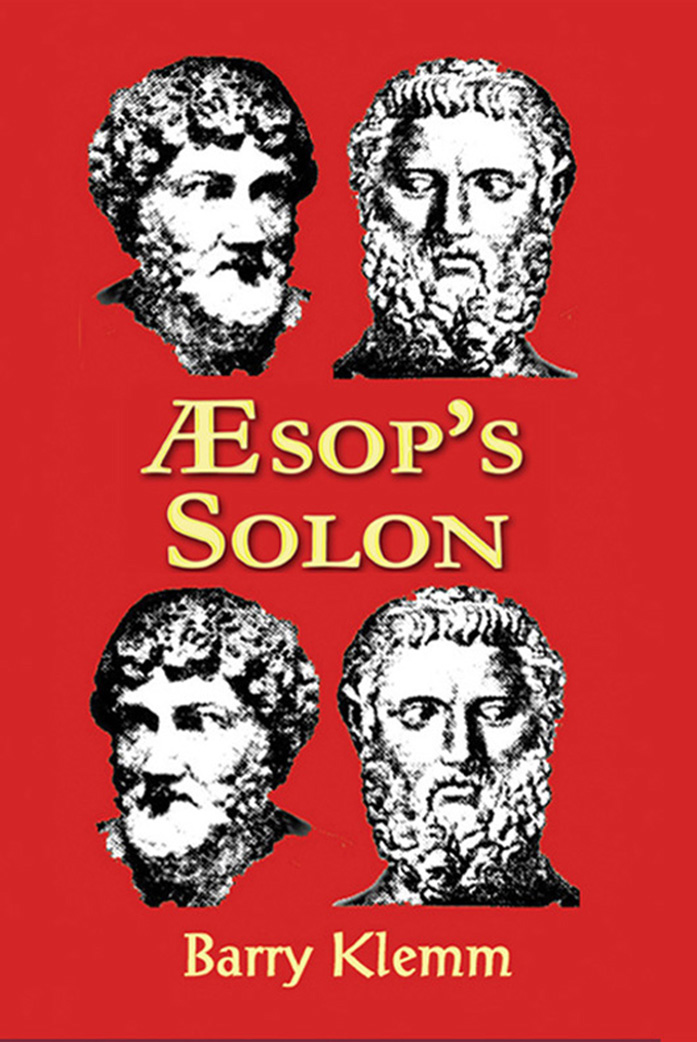
Aesop, the man with a fable to elucidate any situation, finds himself guarding the back of his friend Solon of Athens during the politically seminal year of 594BC, when the latter was foolish enough to get himself appointed Chief Archon of Athens in exceptionally complex and very dangerous circumstances. A free market economy has run through to its ultimate point with the entire population enslaved by the 400 members of the High Council of the Areopagus, resulting in a full scale peasant revolution, and the High Council have appointed Solon to make new laws to save them from their own suicidal profiteering and social excesses. Solon averts the crisis with a series of stunning reforms, establishing the basis of future Democratic governments with the invention of the bicameral parliamentary system and the first use of juries, not to mention certain radical economic innovations, which make him a lot of friends and a handful of exceedingly dangerous enemies. At the same time he must find a way to end a timeless blood feud, and learn to control his own susceptibility to the aphrodisiac effects of absolute power. Aesop's protective role is one to be performed with his tongue as his only weapon but that is well known to be sharper than any sword. In the end it is Aesop who must make Solon understand that in creating a system that will rid the world of tyrants, he has become one himself. But Solon's solution to that problem is the most startling of all... |
Roy Barton was a living legend out in Western Australia, a diver who discovered a sunken galleon complete with a vast treasure in gold ducats only to have the proceeds ripped off by the government, his lover and his friends. Now a movie is to be made about his life and Draper, a down and out writer, is commissioned by some shonky producers to prepare the film script, working directly with Barton. Day by day, Barton’s story unfolds to Draper. It is plain that the authorities have seriously abused their powers to separate the explorer from his treasure, twisting the law, fabricating false documents and backing it up with continual police harassment, but in the end High Court findings have vindicated Barton, and the government have been ordered to return the treasure. Instead, they have resorted to even more intense harassment. Along the way there are many tales of adventure to be told, a classic yarn of treacherous beautiful women, ruthless villains, of storms and sharks and tragedy; but the most amazing thing is that it is all true. Or is it? As the telling of the story of Barton’s life of triumph and betrayal proceeds, Draper begins to discover anomalies; the nuts and bolts of the tale just don’t quite fit together the way they ought to. Draper begins to realise that Barton is a bitter man profoundly deranged by his experiences. He decides to search for the truth, uncertain whether Barton is an extraordinary charlatan, or a man so devastatingly wronged by government, lovers and friends that his mind has become twisted, both of which seem equally possible. He discovers plenty of evidence to support the basic story - court findings, newspaper articles, public records, eye-witnesses accounts - but still the contradictions grow. And not just in the story, but also in the narrator, who is rapidly losing his grip on reality. Troubling and violent scenes occur in which the Barton completely loses control and Draper realises that he is under police surveillance himself. Then Draper’s inquiries in turn begin to feed back, effecting not only the direction of the screenplay but also exacerbating Barton’s condition until, in the end, the writer effectively tips his subject over the brink, and finds he has himself become Barton’s ultimate, and most disastrous, betrayer. |
JARVIS KREEG- BEYOND THE GRAVE! |
Pythagoras lies dying at the end of his long and magnificent life. Part genius, part mystic, he has devoted himself to defining the perfect cosmic system he created, the great unity of numbers and mathematics and the universe. But suddenly, it has all gone horribly wrong—a terrifying secret has arisen within the Brotherhood of his loyal followers, and murders are committed to protect it. |
SHADOWRIDER |
England and Australia met to fight out a historic test match before a huge rampant crowd, a frightening, insatiable monster with 80,000 mouths and unbridled passionate power that keeps in the dungeons below the grandstands a contingent of slaves who must attend its every need - the players, administrators, police and the staff of The Ground. For the thundering horde creates continual chaos over the five days of the test match, and a small team works tirelessly to keep the madness within manageable bounds. We focus on Einstein, a clever young urban aborigine upon whose slim shoulders the responsibility for the upkeep of the stadium will increasingly fall. The laws of the game are those of time-honoured traditions and national honour, but Einstein could not care less about the battle between the colonials and their masters taking place on the arena for the traditions and honour at stake are not his. Yet still, by devotion to his boss Harry Forth, by his mismatched affair with the PR girl Camellia Musgrove, and by the all-pervading notion that the show must go on, he is drawn deeper and deeper into the vortex. In the middle of it all, Harry collapses and Einstein must take control. Without Harry, the fabric that holds it all together begins to unravel, and only Einstein can prevent everything from total collapse. To do so, he must become pseudo-Harry, playing by Harry's iron-will rules. Everyone turns against him because those rules say that everyone must, and even the woman who loves him must betray him, because that too is all part of the game. Resolute Einstein hangs on, and wins through in the end, though only with the help of the unexpected emergence of a great hero just when he is needed most, and the unwitting aid of a rabbit in a cage that is a long way from home.
|
||||